Opaque Illusions: Viola Leddi

STANCE is pleased to announce Opaque Illusions, the first Swedish solo exhibition by Milan- and Geneva-based artist Viola Leddi. In her multidisciplinary practice, Leddi explores the tension between surface and depth, using opacity and illusion to interrogate visual language, cultural memory, and the politics embedded in representation—bringing into focus layered references to feminism, machismo, and avant-garde aesthetics.
If we speak about painting today, it is mandatory to address its structural conditions. For Millennials, as well as for Viola Leddi—who presents her first solo exhibition in Sweden, titled Opaque Illusions—thinking about painting has not been the same since the mid-2010s. In those years, Isabelle Graw was incubating a series of writings that culminated in The Love of Painting: Genealogy of a Success Medium (2018), an essential text for understanding the renewed centrality of painting in contemporary discourse. At the same time, the art system witnessed the rise of Avery Singer, whose practice significantly informed Graw’s reflections. According to the theorist, “new painting” continues to operate through an image of vitality and through effects that exceed materiality, revealing a tension between artistic autonomy and the media dispositifs surrounding it. Singer’s work—engaging with modeling software, automation, and digital protocols—can be read as paradigmatic of the “image-painting” Graw analyzes: no longer confined to its historical medium, but capable of attracting the contemporary gaze by playing with expectations tied to technology and image production itself.
The last time I visited Viola, in her temporary studio at the Swiss Institute in Rome, I raised these ideas not to compare practices or establish genealogies, but to situate her research within the same theoretical momentum around painting that characterizes her generation. Any discourse on the painted image today cannot ignore the technological frameworks shaping daily life and our ways of looking. As Adorno argued decades ago, artistic form is never autonomous from the material conditions of its production—nothing surprising there.
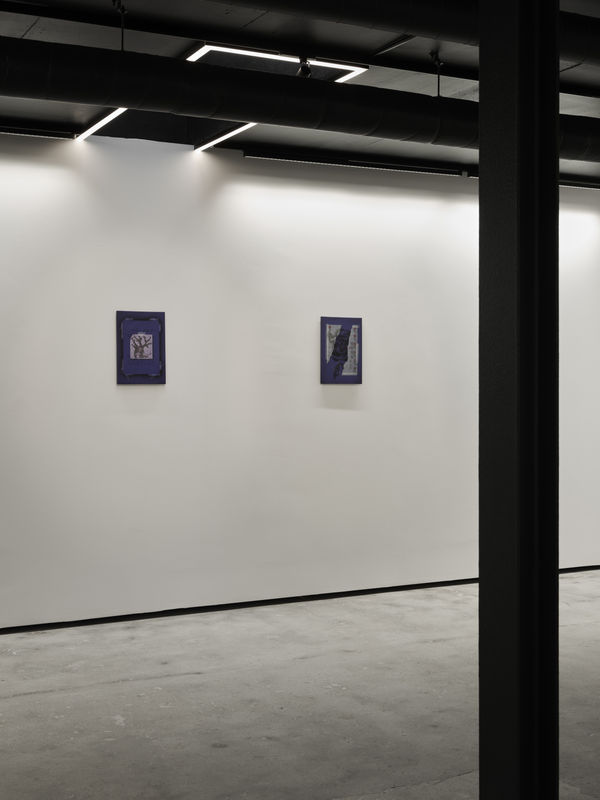
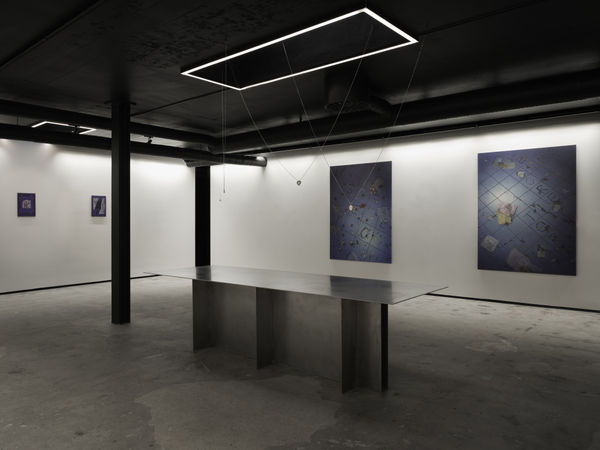
Two small acrylics on cotton poplin (35 × 47 cm) mark a new body of work and signal a further development in Viola’s conception of the pictorial image. She describes these works—Untitled (Love Is…) and Untitled (Fall) (both 2026)—as “vague”: fleeting notes, paintings that never fully became paintings. They depict an element recurring in her practice—a sheet of paper taped to a surface, with traces of adhesive still visible—yet now positioned frontally, as if the subject of a portrait. Beside it appears a small grid-lined note bearing childlike drawings composed within square geometries: a tree with a bird and mushroom in one, roses in sequence in the other.
In Untitled (Fall), the sheet carries asemic writing from 1970 by the Argentine artist Mirtha Dermisache. These works adopt a streamlined process and pursue a more symbolic inquiry, recalling visual poetry and feminist verbo-visual languages of the 1970s. The return to childlike drawing and the disappearance of the grid as background—though preserved in squared paper—underline Viola’s continued engagement with photography as framing device and filter. Her paintings operate as collages rather than hyper-zooms on reality, reworking digital languages through an analog, layered practice that simulates, rather than automates, the processes of the digital image.
Where Singer uses technology as an operational tool, Viola imitates its visual dispositifs and image-production protocols through painterly means. Beginning with drawings, she isolates fragments, develops them digitally, and experiments with palette and spatial relationships before transferring them to canvas through slow layers of airbrush and manual painting. Depth, blur, and chromatic continuity—effects associated with screens—are reconstructed through micro-variations, overlaps, and corrections. The resulting surfaces seem algorithmically produced yet remain the outcome of deliberate, physical labor, prompting viewers to question the boundary between analog construction and digital imagination.
The exhibition is titled Opaque Illusions because opacity is a structural condition of Viola Leddi’s painting. Her surfaces host restrained apparitions and references to pictorial traditions shaped by patriarchal representation, while works such as All Play And No Rules (#1; #2, 2025) evoke game boards, Futurist aerial visions, and feminist visual codes. Each painting becomes a device of dissimulation. This opacity echoes Hubert Damisch’s reading of painting as a system of signs—never transparent, always shifting—and resonates in her amulet-like sculptures of glass and metal, symbolic talismans suspended between perception and cultural construction. Like Graw’s account of contemporary painting, Viola’s practice persists through the negotiation between subjectivity and objecthood, manual labor and concept.
Text: Eleonora Milani
Viola Leddi's (b. 1993, Milan, Italy) paintings and sculptures engage with art history, especially Italian art history, through a critical lens. Her work seeks to reread her own art historical education, questioning iconographies, representations, and stereotypes often relating to the female body. Leddi began her artistic training at Brera Academy in Milan where she received her Bachelor of Fine Arts before continuing at Haute ecole d’art de design (HEAD). In 2022, following the completion of her Master of Visual Arts, the artist was the recipient of the HEAD—Galerie 2022 Prize for which she was awarded a solo exhibition at Geneva —Pace Gallery. Her work has been featured in the Liste Art Fair in Basel, Artissima in Italy, and Art Genève. Leddi was the recipient of the Theodore Stravinsky Foundation Prize in 2022. The artist lives and works in Geneva, she is a co-founder of research group and community, Altalena.
Viola Leddi is represented by VIN VIN Vienna